

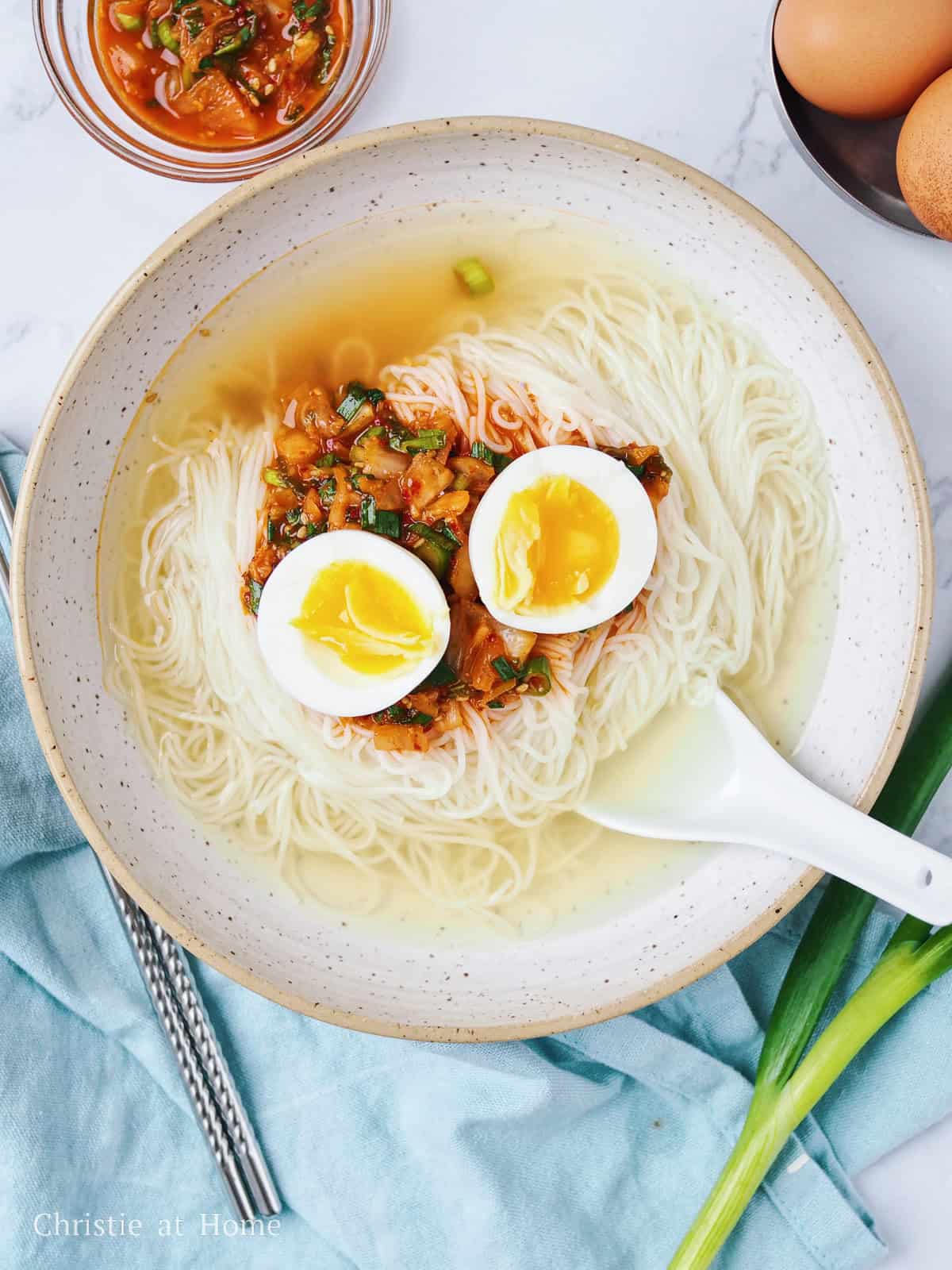
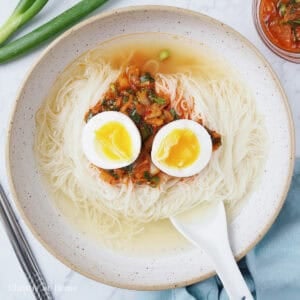
Chewy, thin wheat noodles in warm broth topped with egg and a sweet, spicy, and savory sauce. This easy janchi guksu recipe uses simple ingredients and is ready in 30 minutes. A comforting, restaurant-quality main that's both family-friendly and budget-friendly.
Jump to:
Janchi Guksu (aka 'Warm Korean Noodles') means 'banquet noodles' or 'feast noodles' and is usually eaten on special celebrations, such as weddings or birthdays, hence the name.
Noodles symbolize "longevity" in Asian culture, which is why it's served on these occasions. But this dish is also great for a busy weeknight or a cold day!
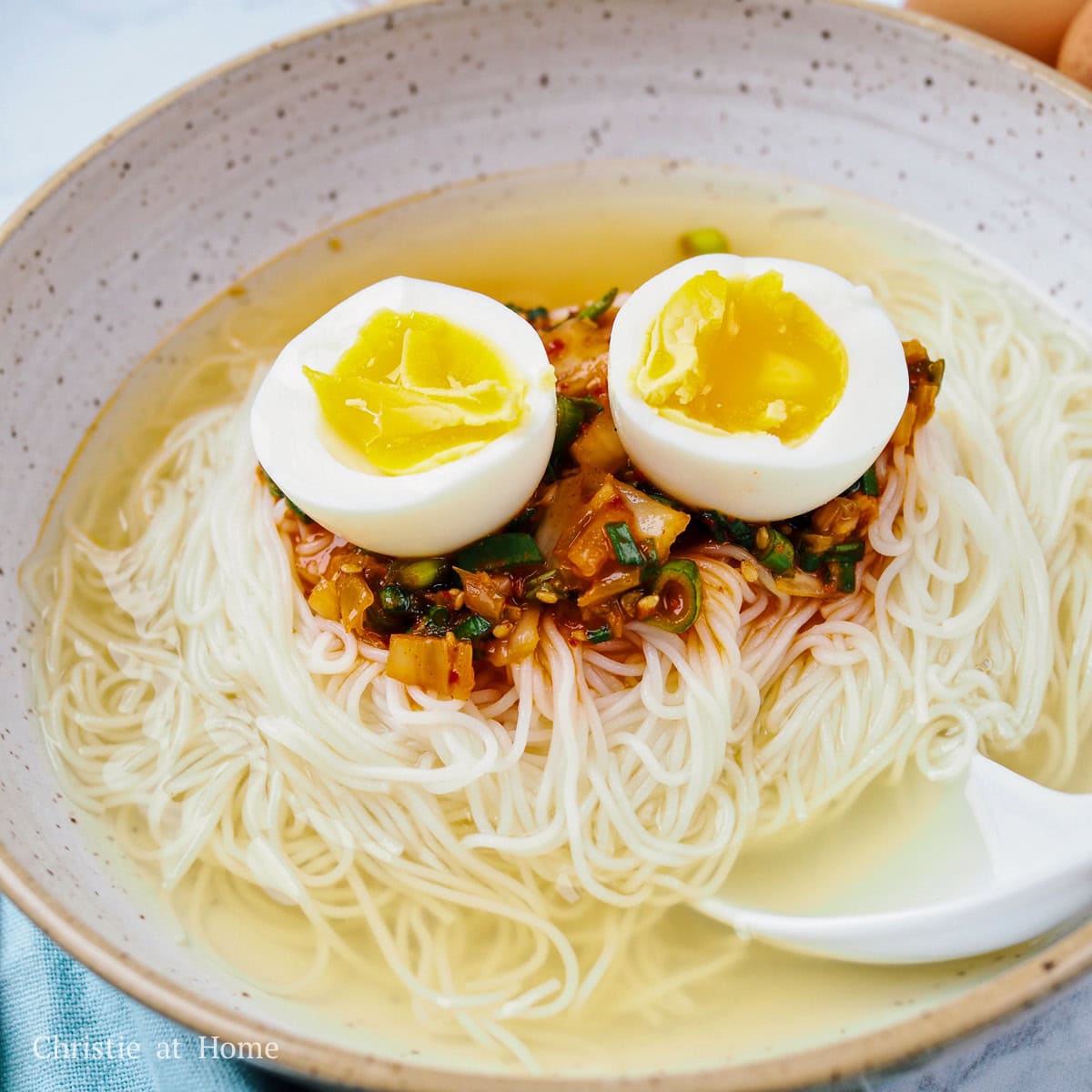
The chewy somyeon noodles pair deliciously with the light, clear anchovy broth, and the soft-boiled egg. However, it's the sweet, savory scallion kimchi sauce that gives these noodles a punch of flavor!
Why This Recipe
- I've tested both homemade anchovy broth and anchovy coin broth tablets, and I recommend the tablets for their stronger flavor and convenience.
- Many janchi guksu recipes result in soggy noodles. Cooking the noodles 1 minute less than the package instructions, then rinsing and gently rubbing them under cold water, helps maintain a firm, chewy texture.
- Use well-fermented kimchi to achieve a deeper, more balanced flavor in the sauce.
Ingredients & Substitutes
Please scroll to the recipe card below for exact measurements.
- Somyeon Noodles (aka Somen Noodles): Dry, white, 1-mm thin wheat noodles, typically found at the Korean grocery store, like H Mart. Substitution: Soba buckwheat noodles.
- Large Eggs: Boiled for a topping. You can also pan-fry the beaten eggs and thinly slice them as a jidan or "egg garnish".
Sauce
- Green Onion
- Kimchi: Use well-fermented napa cabbage kimchi [I recommend Bibigo or Jongga]. Look for translucent, tender cabbage for the necessary acidity and spice.
- Regular Soy Sauce: Any all-purpose brand works [I recommend Kikkoman or Lee Kum Kee]. Low-sodium or light soy sauce also work.
- White Granulated Sugar: Or use granulated cane sugar or honey.
- Toasted Sesame Oil: Adds a nutty aroma [I recommend Kadoya or Maruhon]. Avoid substituting with untoasted sesame oil as it doesn't taste the same.
- Sesame Seeds: These need to be ground to bring out the flavors, using clean hands or a mortar and pestle.
- Gochujang (optional): A thick, sweet, smoky Korean chili paste [I recommend Chung Jung One or Sempio]. Level 1-3 (Mild to Medium) heat is recommended for this recipe.
Broth
- Cold Water
- Anchovy Coin Broth Tablets: Round, gray tablets made of anchovy powder, kelp, and vegetables [I recommend the brand Kitchen Story]. Substitution: Homemade anchovy broth or dashi stock, remove the cold water above.
- Onion
- Green Onion
- Dried Kelp (optional): A dried sheet of sea kelp that adds umami flavor. Do not rinse the sheets off with water, or you will remove the flavor!
Note: Asian ingredients are typically available at Korean or most Asian grocery stores, or you can check online.
Expert Tips
- Stir the broth occasionally as it simmers to fully dissolve the broth tablets and avoid any grainy bits.
- Add 1 teaspoon salt and 2 teaspoon white vinegar to the water when boiling eggs. This helps prevent egg whites from leaking if shells crack and makes peeling easier.
- Transfer the eggs to an ice bath immediately after cooking to make peeling the easier.
- Cook the noodles last to keep their texture chewy. If left sitting, they will absorb moisture and become soggy.
- Avoid overcooking the noodles. Start checking at the 2-minute mark and strain them as soon as they reach the desired doneness.
- Rinse the cooked noodles under cold running water, gently rubbing them with clean hands to remove excess starch, which can make them less chewy.
Instructions
Below are step-by-step instructions on how to make janchi guksu:
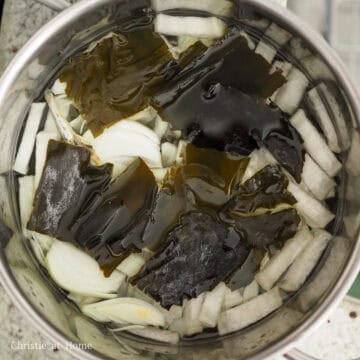
- Make the broth: In a medium pot, add cold water, anchovy coin broth tablets, dried kelp, onion, and green onion. Cover and bring to a boil on medium-high heat. Then reduce to a rolling simmer on low-medium heat for 10 minutes, stirring occasionally to dissolve the tablets.
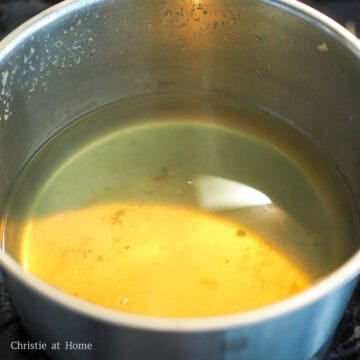
- Strain the broth: Remove the green onions, onions, and kelp from the broth with a slotted spoon. Cover the broth to keep hot and set aside.
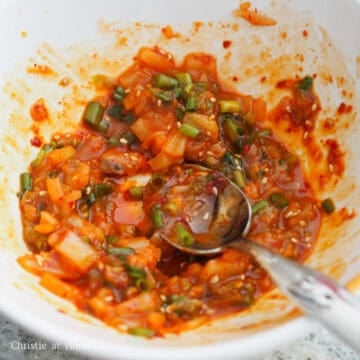
- Make the sauce: In a small bowl, combine the sauce ingredients as listed above and set aside.
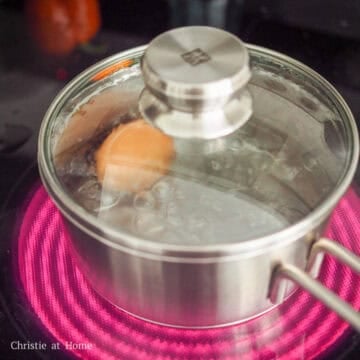
- Boil the eggs: In a small pot, boil the eggs for 7-8 minutes for soft-boiled eggs or 10 minutes for hard-boiled eggs. Optional: Before boiling, add 1 teaspoon of salt and 2 teaspoon white vinegar to the water, which makes the peeling process easier. Transfer the boiled eggs to an ice bath. Then peel and slice the eggs into halves and set aside.
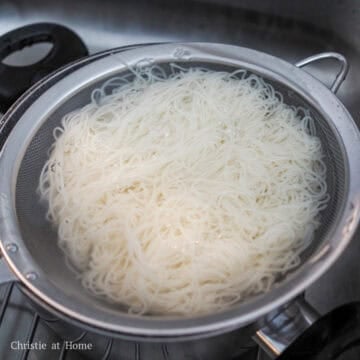
- Cook the noodles: Lastly, boil the somyeon noodles for 2-3 minutes, or until al dente. Then strain and rinse under running cold water while gently rubbing the noodles together with clean hands. Then strain the noodles to remove any excess water.
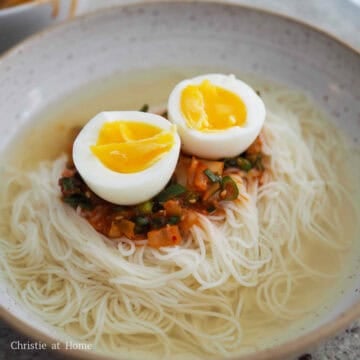
- Assemble the bowls: Divide the strained noodles between two large serving bowls. Top with equal portions of sauce and eggs. Then ladle the hot broth into each bowl, around the noodles and enjoy hot!
Variations
- Meat version: Replace the boiled eggs with ½ lb (226 g) thinly sliced beef brisket or flank steak and marinate it with 1 teaspoon regular soy sauce, ½ teaspoon sesame oil, ½ teaspoon sugar, and ¼ teaspoon black pepper. Then pan-fry in 2 teaspoon neutral oil until cooked through.
Topping Ideas
- Zucchini - Julienned and sautéed with salt and sesame oil.
- Carrots - Julienned and sautéed with salt and sesame oil.
- Fish cake sheets - Cut into ½-inch strips, then pan-fry, and season with a touch of soy sauce, sesame oil, and sugar.
Pairing Suggestions
Janchi Guksu pairs well with:
- Appetizer: Korean Scallion Pancake
- Meat Dish: Korean Bulgogi Beef
- Rice Dish: Kimchi Fried Rice
- Vegetable Side Dishes: Korean Cucumber Salad or Beansprout Salad.
Storage & Reheating
- Leftover janchi guksu can last up to 2 days when stored in an airtight container in the fridge once cooled. I recommend storing the different components separately so the noodles don't become soggy. To enjoy, reheat the broth on the stovetop until heated through, and pour it over the cold noodles, then top off with the cold eggs and sauce.
- Freezer-friendly? Janchi guksu is not ideal for freezing as the noodles will become soggy and the eggs will taste rubbery.
FAQ
Soggy noodles can be caused by several reasons, which includes overcooking the noodles, not taste-testing them at the 2-minute mark, waiting too long to strain them, failure to rinse them under running cold water, or not rubbing the noodles to remove excess starch.
📖 Recipe
Easy Janchi Guksu

Ingredients
- 7.05 oz somyeon noodles (aka somen noodles), 1-mm thick
- 2 large eggs
Sauce
- ¼ cup kimchi finely chopped
- 1 green onion finely chopped
- 1 tablespoon regular soy sauce
- 1 tablespoon white granulated sugar
- 1 teaspoon sesame oil
- 1 teaspoon sesame seeds
- 1 tablespoon gochujang (optional for spicy version)
Broth
- 6 cups water cold
- 5 tablets anchovy coin broth
- 6 pieces kelp dried kind, optional
- 1 small onion julienned
- 1 green onion chopped into 1" long pieces
Instructions
- In a medium pot, add cold water, anchovy coin broth tablets, dried kelp, onion, and green onion. Cover and bring to a boil on medium-high heat. Then reduce to a rolling simmer on low-medium heat for 10 minutes, stirring occasionally to dissolve the tablets.
- Remove the green onions, onions, and kelp from the broth with a slotted spoon. Cover the broth to keep hot and set aside.
- In a small bowl, combine the sauce ingredients as listed above and set aside.
- In a small pot, boil the eggs for 7-8 minutes for soft-boiled eggs or 10 minutes for hard-boiled eggs. (Optional: Before boiling, add 1 teaspoon of salt and 2 teaspoon white vinegar to the water, which makes the peeling process easier).Transfer the boiled eggs to an ice bath. Then peel and slice the eggs into halves and set aside.
- Lastly, boil the somyeon noodles for 2-3 minutes, or until al dente. Then strain and rinse under running cold water while gently rubbing the noodles together with clean hands. Then strain the noodles to remove any excess water.
- Divide the strained noodles between two large serving bowls. Top with equal portions of sauce and eggs. Then ladle the hot broth into each bowl, around the noodles and enjoy hot!

Heidi | The Frugal Girls
You did such a fabulous job making this recipe easy! I specifically loved your step by step instructions that included photos for each step. 💕💕
christieathome
Thank you Heidi! Happy to share the step by step pictures.
Rosemary
Mmm you had me at chewy noodles. I always under cook my ramen because I love to keep the chewiness there
christieathome
Yes undercooking that ramen is so key! Just 2 minutes total is all it takes!
Mavis Kalambi
So awesome
christieathome
Thanks so much for making my recipe, Mavis! So happy you enjoyed it!
Alex
Exactly the kind of flavours I have been craving lately! I am so excited to make this again and again!
christieathome
Thanks so much Alex!!! It's really so good!